
Most pets take medication at some point, whether it is a short course of antibiotics or a daily pill for the rest of their life. The medicine itself usually is not the hard part. The hard part is remembering it, every time, at roughly the same time, for as long as it is needed.
That is a bigger ask than it sounds. Vets who study this consistently find that even attentive owners struggle once a pet is on more than one medication or needs dosing more than twice a day. It is not a sign of carelessness. It is what happens when a daily routine depends entirely on memory.
Why consistent timing matters
For short courses, like a week of antibiotics, the main goal is simply finishing the full course, even after your pet seems better. Stopping early is one of the most common reasons a treatment does not fully work.
For long-term medications, timing matters more. Treatments for thyroid conditions, heart disease, seizures, and pain are often designed to keep a steady level of the drug in your pet's system. Giving doses at irregular times lets that level rise and fall more than intended, which can make the medication less effective. This is why vets often ask owners to give a chronic medication at roughly the same time every day. Pairing it with something else in the routine, like a meal, makes it easier to remember.
What actually causes missed doses
It is rarely one big mistake. It is small, ordinary things. A pet is boarded for the weekend and the sitter was not given exact times. A teenager gives the evening dose but does not tell anyone. A refill runs out on a Sunday when the pharmacy is closed. Missed doses add up quietly, and by the time a pattern shows up, it can be hard to remember whether it happened once or six times.
Two things reliably help. The first is a schedule that lives outside your memory, so it does not depend on anyone remembering. The second is a shared record, so that when more than one person is involved, everyone can see what has already been given.
If a dose is missed
Always follow your vet's specific instructions, since they vary by medication. As a general rule, if you catch it soon after the scheduled time, give the dose as normal. If it is close to the next dose, most vets advise skipping the missed one rather than doubling up. Never give two doses at once unless your vet has told you to. If you are ever unsure, a quick call to your vet or an emergency line is worth it.
Logging a missed dose, not just the ones given, is worth doing too. A pattern of missed doses is useful information for your vet, and easy to lose if it only exists in memory.
Tracking medications in PetNid
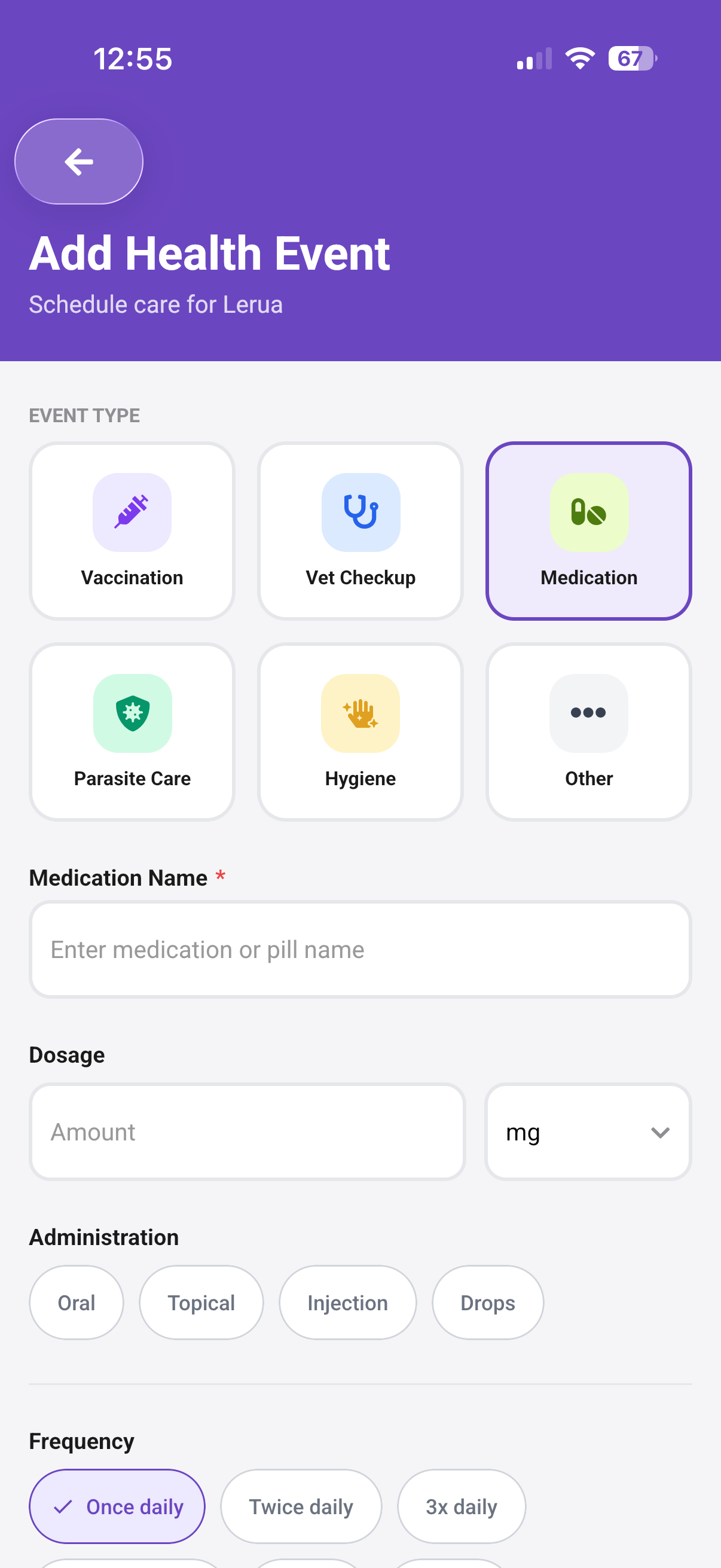
PetNid turns a medication schedule into something you set up once and then simply follow. Each medication gets its own reminders, its own course length, and its own history, so nothing depends on remembering who gave what.
Remind if missed · alert 30 min after scheduled dose
Course ending soon · notify 2 days before course ends
Marking doses as given
Each scheduled dose appears on your pet's Timeline, where you mark it as given. On the Medication Details screen, a week view shows the pattern at a glance. A green check marks a dose that was given, and a red mark shows one that was missed. If more than one person gives doses, everyone marking them in the same place removes the guesswork about who did what.
- Every scheduled dose shows up on the Timeline until it is marked as given
- Medication Details shows the next dose, today's doses, and a week-at-a-glance view
- A missed dose stays visible rather than quietly disappearing from the schedule
- Dosage, frequency, course dates, and reminder settings are all in one place if you need to check them
PetNid does not track which specific person marked a dose as given, only whether it was given or missed. For a household sharing the task, agreeing on one simple rule, mark it the moment it is given, keeps the record accurate.
- Add each medication with its exact dose, frequency, and timing
- Turn on a per-dose reminder for anything given more than once a day
- Add a missed-dose alert for medications where timing really matters
- Mark each dose as given right away, especially if more than one person helps
- Check in on the history if you notice doses being missed often, and mention it to your vet
If your pet is also due for other care, the parasite prevention guide and the vaccination guides cover the rest of a regular care calendar.
Never lose track of a dose again
Set up reminders for every medication and see exactly what has been given.