
Most owners only think about weight at the vet, once or twice a year. That is often enough to catch a big change. It is not enough to catch the slow, steady drift that happens over months. That kind of change is nearly invisible day to day, but obvious once you look at three or four readings side by side.
Weight is also one of the few health markers you can measure at home with no special equipment and no training. That makes it one of the easiest ways to build a useful health picture over time, for very little effort.
Why weight changes matter
Gradual weight loss can be one of the earliest signs that something is wrong, sometimes appearing weeks before any other symptom. A pet can be eating normally, playing normally, and still be quietly losing weight due to an underlying condition. Because the change is slow, it is easy to miss just by looking at your pet every day.
Gradual weight gain is just as easy to miss, and it carries its own risks. Extra weight adds strain to joints, raises the risk of diabetes, and makes the heart and lungs work harder. It also tends to happen slowly enough that it is often only obvious in hindsight, looking back at photos or an old collar setting.
A rough guide vets often use: an unexplained change of around 10% of body weight, in either direction, is worth a conversation with your vet. For a small cat or small dog, that can be a surprisingly small number of kilograms, which is another reason a single glance is not always enough to notice it.
How often to check
For a healthy adult dog or cat, checking weight about once a month is usually enough to catch a meaningful trend without becoming a chore. Puppies and kittens grow quickly and are often weighed weekly while they are young. Senior pets, and pets being managed for a health condition, are often weighed more often, since vets frequently ask owners to track weight between appointments.
Reading a trend, not a single number
A single weigh-in is a data point. A history is a story. A weight that is stable for months and then shifts is more informative than any one reading, because it tells you when something changed, not just that it did. That is also what makes an unexplained shift worth mentioning at your next vet visit: not the number itself, but the fact that it moved.
Tracking weight in PetNid
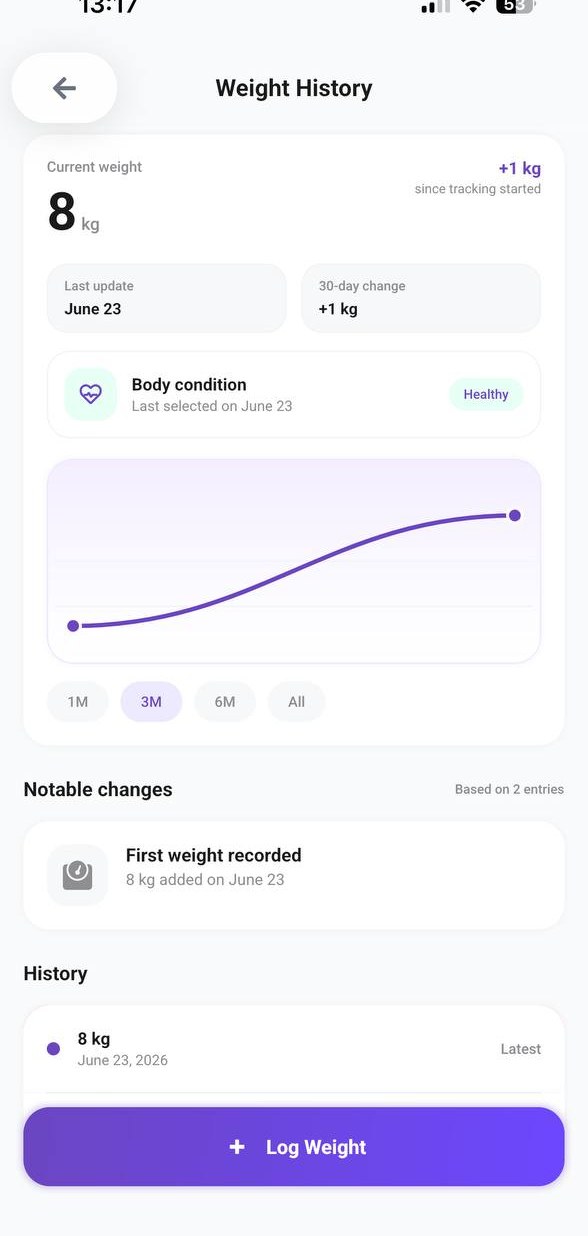
PetNid keeps every weigh-in in one place and turns it into a simple chart. A trend becomes something you can see, not something you have to remember or calculate.
Where to find it
Weight History sits on the Pet Care tab, alongside food and feeding and the symptom diary, or you can reach it from the add menu by tapping Log Weight. Either way, it opens the same running history for that pet.
- Log weight in kilograms or the unit you prefer, with an optional body condition note
- See the change since tracking started and over the last 30 days at a glance
- Filter the trend chart by 1, 3, or 6 months, or view the full history
- Every past entry stays in the log, so a slow trend is easy to spot
- Weigh your pet on a consistent schedule, monthly for most healthy adults
- Log every reading rather than trying to remember it
- Watch the trend line, not just the latest number
- Mention an unexplained 10% change, up or down, to your vet
- Weigh more often for puppies, kittens, seniors, and pets managing a condition
Weight is one part of a bigger health picture. The symptom diary guide covers how to track appetite, energy, and other changes alongside it. For a closer look at the feature itself, see the Pet Weight Tracker page.
Start tracking your pet's weight
Log entries in seconds and let PetNid chart the trend for you.